Sunday, May 24, 2015

How to Check Yourself for Diastasis Recti


A lot of you mommies out there inbox me from time to time with questions regarding abdominal separation after pregnancy. This separation, also known as Diastasis Recti or DA, is a medical issue that must be addressed depending on the level of severity. 

How to Check Yourself for Diastasis Recti:
  1. Lie on the floor on your back with your knees bent, and the bottoms of your feet flat on the floor. (You may use a yoga mat if you have a hardwood floor)
  2. Place one hand on your abdomen with the tips of your fingers across your belly button.
  3. Next, press your fingertips into your abdomen, along the "imaginary line" that separates the two halves of your abdominal muscles. (make sure your tummy is relaxed and not flexed)
  4. Now, you are going to perform a crunch movement, curling your upper body towards your knees (make sure your back is flat on the ground).
  5. Move the tips of your fingers along the separation line and feel for any gaps in between the two halves of your abdominal muscles.
  6. *If you experience a gap in between your abdominal muscles of 2 to 2 1/2 finger widths, then you have Diastasis Recti. Anything under two finger widths is usually considered mild and should heal on its own.

If you find yourself with a larger degree of DA, you should refrain from most exercises-especially ones targeted at the abdomen as these moves can make the level of DA worse. 

When in doubt, always speak to your doctor and get a proper examination.


            Friday, May 22, 2015

            The Truth About Good and Bad Carbs

            Is it just me or does it seem like almost every fad diet out there either lowers your carb intake or forbids them completely??

            Carbohydrates have gotten such a bad reputation over the years when in actuality, they are a very useful macronutrient that is vital to shaping your body. 

            Eating an abundance of carbs can fuel your training and help grow your muscles efficiently. Not eating enough carbs can leave you feeling fatigued or sluggish and can hinder your performance during a workout.

            There are two types of carbs: simple (also known as bad) and complex (also known as good). 


            Simple carbs have very little nutritional value and are composed of simple sugars. Typically, these foods are lower in fiber while being awfully higher in sugar content. Believe it or not, fruits and some veggies are also considered to be simple carbs.

            Simple carbs to eat less of are:

            • soda
            • candy
            • artificial syrups
            • sugar
            • fruits
            • white rice, white bread, and white pasta
            • potatoes (which are technically a complex carb, but act more like simple carbs in the body)
            • pastries and desserts

            The complex carbs are also known as the carbs that you should eat if you want to live a healthier or cleaner lifestyle. They are made up of fewer sugars and take much longer to digest, leaving you feeling fuller longer. This benefit usually cuts down on the tendency to overeat or snack.

            Complex carbs to eat more of are:

            • whole grains
            • brown rice 
            • some veggies
            • sweet potato
            • yams
            • oatmeal
            • milk
            • high fiber cereals
            • lentils
            • wild rice
            • couscous

            So, what is the real difference between "good" and "bad" carbs?


            What most people do not understand is that a carb is a carb. It does not matter if it is good, bad, pretty, or ugly-it's still a carb.

            Both simple and complex carbohydrates are used in the same exact way. Carbs are turned into glucose (blood sugar) in the body and are used as energy. Glucose is used in the cells of the body and in the brain. Any unused glucose is stored in the liver and muscles as glycogen for use later. Meaning, if you don't workout and burn off those stored sugars, it will convert it's ugly little self into FAT.


            But, you do want to be wise with what carbs you choose. Obviously, you know a cupcake is not going to be a wise choice for a snack. However, I wouldn't spend too much of your life dreading over whether or not to make white or brown rice for dinner. Obviously white rice is slightly better than a cupcake. you get the idea.

            On a final note, here are 3 tips to remember:

            1. Choose your carbs wisely.
            2. Eat your carbs in moderation.
            3. Workout at least 5 days a week for 30 minutes (the recommended amount) to burn off stored glucose and avoid excess fat storage.


            Thursday, May 21, 2015

            Ultimate Female Guide to Getting Lean


            If you are on this site right now, chances are that you want to gain lean muscle. Building your body is not the easiest thing to do. It takes patience, time, and a lot of effort on your part. But just as with anything else, results will start to show if you keep pursuing. 

            The only way proven to add muscle and curvature to your body is through the act of lifting heavier weights. Lay off the hour of treadmill running and countless repetitions and just into the world of weight lifting.

            In order to gain muscle mass, you need to focus on two things:
            • heavy weights
            • low reps
            Here are typical rep ranges below according to their goals:
            I personally find myself aiming for 6-8 reps of each workout move when I lift weights. Figure out what you goals are and then apply the rep range that best suits you!

            But what if I get big or bulky? Keeping the answer short, YOU WON'T. If anything, lifting weights will make your body look better than ever before and do a world of good on your muscles, bones, and posture. 

            As females, our bodies simply do not have enough of the growth hormone testosterone to produce ample amounts of lean muscle mass. Our bodies simply cannot bulk up like theirs can. End of story. 

            Exercise
            Ever notice that there are no "women exercises" or "men exercises?" This is due to the fact that both genders should train the exact same way. 

            Walk into the gym-where do you see a majority of the women? What are they doing? Chances are, they are probably on the treadmill and elliptical while the weight room is free of any female human being. WHY? Women are either intimidated or believe weights will cause them to bulk up. If they are in the weight room, they may have a small dumbbell in their hand doing countless repetitions over and over again. I can go ahead and tell you that endless cardio and tiny weights won't get you closer to your goals of a toned, curvy physique.

            So, what should I be doing? Here are some moves that are great for transforming a woman's body:
            • Lunges
            • Squats
            • Bicep Curls
            • Overhead Press
            • Deadlifts
            • Lying Leg Raises
            • Dips
            • Kettlebell Swings
            The Spot Reduction Myth
            As women, we tend to develop our own trouble areas, particularly the lower belly, back of the arms, hips, thighs, and butt. We often desire to burn fat in these areas and to tone it all up. 

            It is true that there is no way to target fat loss in a particular area. You can work that area by targeting the whole muscle group with a lifting, bodyweight, or HIIT exercise, but your overall best bet will be mixing cardio with a clean diet to reduce your overall body fat percentage.

            Aim to get your heart rate up and to sweat! 

            Don't forget to warm up!
            Something that many people forget or neglect to do is properly warming up your muscles before beginning a workout. This can lead to sprains, pulled muscles, and other injuries.

            My favorite warm up usually involves a few yoga poses to help stretch various muscles at one time. My favorite stretch is the wide angle forward bend which stretches those hamstrings! If you are wanting something a bit more active for your warm up, good ole jumping jacks or a 5 minute jog is better than nothing!


            Diet & Nutrition
            When taking proper diet into account, the first thing to consider is finding your BMR or basic caloric rate. This number will tell you the basic amount of calories that you need daily in order to sustain life.

            Here is a simple equation chart that I made below to help you figure yours:

            For example, here is mine:

            655+ 499.2+ 288- 117.5 = 1324.7 calories needed to survive daily.

            Next, you need to figure out how active are you and add the appropriate calories to your baseline total.

            Here is a chart I create to help you:

            Using the Harris Benedict Formula, determine your total daily caloric needs. Keep in mind, this is just an average because let's face it-one person's thought of "sedentary" might be another person's "lightly active" or vice versa.
            • Sedentary (little or no exercise): BMR x 1.2
            • Lightly active (easy exercise/sports 1-3 days/week): BMR x 1.375
            • Moderately active (moderate exercise/sports 3-5 days/week): BMR x 1.55
            • Very active (hard exercise/sports 6-7 days a week): BMR x 1.725
            • Extremely active (very hard exercise/sports and physical job): BMR x 1.9
            Here is mine:
            1324.7 x 1.55 = ~2053 calories per day needed
            *I am still breastfeeding my toddler so I add around 200 calories extra per day to this number*

            More nutritional tips to remember:
            • Drink at least half your body weight in oz. of water per day. I usually aim for 100oz. daily. If your body isn't properly hydrated, it will not have the optimal cellular function it needs to build new, quality muscle.
            • Eat enough protein. Aim for 1 gram of protein per pound of body weight. I weigh 120lbs so I aim for at least 120 grams of protein daily.
            • Take fish oil. Fatty acids does wonders in helping your body to burn unwanted fat while creating new muscle. Personally, I have noticed a big difference with this. I also love chowing down on salmon for dinner!
            • Eat healthy fats. Healthy fats are Omega 3s, coconut oil, avocado, etc. FAT DOES NOT MAKE YOU FAT. Eating an excess of carbs (or sugar) that turns into sugar that is stored and not burned as energy creates fat. Please do not believe all fats are bad for you.
            Supplementation

            Supplements are amazing. They enhance your performance, help out with endurance, and can even increase your strength capacity.

            Someone once asked me, "Can I get by without taking supplements?" 
            The truth, short and simple, is going to be yes and no. Supplements are fabulous, but they are not required. They help to fill in the gaps or deficiences that you may need help with.


            Supplements were created to do just that-supplement your diet and routine. Nutrition is such an important aspect of your workout routine because your body takes what you fuel it with and spits out magic. With the right fuel, great things can happen. 

            Sure, you can get by with taking zero supplements-it just might take a bit longer to reach your goals. 

            First and foremost, every woman needs a good protein powder. The average personally typically needs around 1 gram of protein per pound of bodyweight. So if you are 120lbs, you will need at least 120 grams of protein per day. While this may seem easy (in your mind) to meet this through your daily dietary intake, sometimes it isn't always so easy to eat this much protein. And if you are very physically active, you will need more grams of protein daily to repair your muscles. This is where protein powders rock. 


            So, what supplements do I personally recommend? 
            • A good multivitamin to cover your bases (brand does not matter too much here, but make sure it has enough of what you need)
            • Vitamin D or extra Calcium (for those who lift, you want healthy bones to continue lifting, right?)
            • Fish oil (I love MRM's Smart Blend)
            • A preworkout powder to get you pumped and increase stength/endurance for your workout (I use Driven from MRM. It is all natural and does not make me feel jittery like other preworkout powders.)
            • Amino Acids (I take BCAA Reload from MRM)
            • A postworkout recovery powder (I love the Natural Whey Protein from MRM in chocolate)
            I love MRM supplements and use them daily-regardless if I'm working out or not. Most of their products are safe to use while breastfeeding and during pregnancy. If you need to see the list of which ones, click here.

            You can use my personal discount code below to get 40% off your order. It is good for everything and anything, each and everytime you order.


            But, what if I do not want to take a protein powder everyday? No problem, here is a few great foods that are super high in protein:
            • Chicken
            • Beef
            • Pork
            • Fish
            • Eggs
            • Tofu
            • Tempeh
            • Soybeans
            • Yogurt
            • Milk
            • Nut Butters
            • Cheese


            Wednesday, May 20, 2015

            7 Day Hard Legs Weekly Workout Challenge

            Welcome to your last weekly workout challenge. This week, we will target your legs.

            7 Day Hard Legs Weekly Workout Challenge


            Day One
            5 Single Leg Glute Bridge Extensions
            5 Glute Kickbacks
            5 Lunges
            5 Side Lunges
            5 Mountain Climbers

            Day Two
            10 Single Leg Glute Bridge Extensions
            10 Glute Kickbacks
            10 Lunges
            10 Side Lunges
            10 Mountain Climbers

            Day Three
            15 Single Leg Glute Bridge Extensions
            15 Glute Kickbacks
            15 Lunges
            15 Side Lunges
            15 Mountain Climbers

            Day Four
            20 Single Leg Glute Bridge Extensions
            20 Glute Kickbacks
            20 Lunges
            20 Side Lunges
            20 Mountain Climbers

            Day Five
            25 Single Leg Glute Bridge Extensions
            25 Glute Kickbacks
            25 Lunges
            25 Side Lunges
            25 Mountain Climbers

            Day Six
            30 Single Leg Glute Bridge Extensions
            30 Glute Kickbacks
            30 Lunges
            30 Side Lunges
            30 Mountain Climbers

            Day Seven
            35 Single Leg Glute Bridge Extensions
            35 Glute Kickbacks
            35 Lunges
            35 Side Lunges
            35 Mountain Climbers

            Directions:

            Single Leg Glute Bridge Extensions
            • Lie on your back with your knees bent so that your feet are flat on the ground.
            • Press up through the feet to go into a “bridge” so that your bodyweight rests in your feet and shoulders.
            • While in this position, extend one leg completely before placing it back down on the floor while lowering your body from the bridge.
            • Alternate which leg extends each time you go up into the bridge.
            • The backs of thighs (hamstrings) and glutes are the main targets during the bridge, while you will feel the leg extension in your quadriceps.
            Glute Kickback
            • Get into a quadruped position with all four limbs on the floor.
            • Your hands should be lined up directly under your shoulders and your knees should be directly under your hips.
            • While keeping your knee bent, lift up one knee off the floor and drive your leg up toward the ceiling until your thighs become aligned with your torso.
            • Lower your knee back toward the floor, and immediately move onto the next repetition.
            • Perform all repetitions on one leg before switching to the opposite leg.
            Lunges
            • Stand up straight, with your legs hip-width apart. Place your hands on your hips. Flex your abdominal muscles inward and upward. Step forward with your right foot approximately 2 or 3 feet.
            • Lift your left foot up slightly, so that the toe is in contact with the floor, but your heel is not.
            • Bend both of your knees at the same time. The aim is to make both of your knees stop at a 90 degree angle. Make sure your right knee does not go over your toe line.
            • Pause in this position for 1 to 5 seconds. Stopping your forward momentum will help you to put more effort into rising from the lunge.
            • Push off of your right heel to rise. Return your right leg to its starting position.
            • Repeat with the left leg.
            Side Lunges
            • Stand with your feet set about twice shoulder width apart, your feet facing straight ahead.
            • Clasp your hands in front your chest.
            • Shift your weight over to your right leg as you push your hips backward and lower your body by dropping your hips and bending your knees.
            • Your lower right leg should remain nearly perpendicular to the floor.
            • Your left foot should remain flat on the floor.
            • Without raising yourself back up to a standing position, reverse the movement to the left. Alternate back and forth.
            Mountain Climbers
            • Start the exercise by lying face down on the floor.
            • Straighten out your arms and then touch your knees down to the ground or floor.
            • Now you are ready to lift yourself up into position. When doing this, be sure that your hands are directly under your chest at a width that is slightly more than your shoulder length distance.
            • Once you have settled into position and checked the position of your hands you should be sure to keep your legs stretched out, ensuring that they are properly lined up with the rest of your body. Pay special attention to your knees as many people tend to create a gap here but that should be avoided. If the recommended position is uncomfortable for you, it is alright to modify it slightly as long as you maintain the correct posture.
            • Now you should stretch out your left leg for stability. Bend your right knee and bring it up in the direction of your right hand. At this point, you should be in a similar position to the one you would be in if you were climbing a mountain or tree (hence the name) except horizontal instead of vertical.
            • After bringing your right knee up, return it to the original position and do the previous step with your left leg. (Once again, bend the left knee and bring it up towards the left hand mimicking the actions of a mountain climber)


            Monday, May 18, 2015

            7 Day Build-a-Booty Weekly Workout Challenge

            The second week of May is here and we bring you a new workout challenge! Continuing on from last weeks, 7 Day Muffin Top Workout Challenge, here is your next challenge focusing on building a booty in no time.


            7 Day Build-a-Booty Weekly Workout Challenge

            Day 1
            10 Donkey Kicks
            10 Skater Lunges
            10 Glute Bridges
            10 Lunge Kicks
            10 Squat Jumps

            Day 2
            15 Donkey Kicks
            15 Skater Lunges
            15 Glute Bridges
            15 Lunge Kicks
            15 Squat Jumps

            Day 3
            20 Donkey Kicks
            20 Skater Lunges
            20 Glute Bridges
            20 Lunge Kicks
            20 Squat Jumps

            Day 4
            25 Donkey Kicks
            25 Skater Lunges
            25 Glute Bridges
            25 Lunge Kicks
            25 Squat Jumps

            Day 5
            30 Donkey Kicks
            30 Skater Lunges
            30 Glute Bridges
            30 Lunge Kicks
            30 Squat Jumps

            Day 6
            35 Donkey Kicks
            35 Skater Lunges
            35 Glute Bridges
            35 Lunge Kicks
            35 Squat Jumps

            Day 7
            40 Donkey Kicks
            40 Skater Lunges
            40 Glute Bridges
            40 Lunge Kicks
            40 Squat Jumps

            Instruction
            Donkey Kicks:
            • Start on all fours, hands shoulder-width and knees hip-width apart.
            • Keeping your right foot flexed and leg bent, raise your right leg and press your heel toward the ceiling until your foot is directly above your butt.
            • Squeeze your glutes and slowly return to starting position but keep your knee off the ground.
            • Repeat.
            Skater Lunges
            • Perform a reverse lunge with your back leg slightly at an angle.
            • Leap to the side and bring the opposite leg behind you, only tapping your toe to the ground.
            • Immediately jump back the other direction and continue alternating until you feel the burn.
            • Form check: Keep your knees bent and stay as low as possible to really work your quads.
            Glute Bridges
            • Lie faceup on the floor with your knees bent and your feet flat on the floor.
            • Raise your hips so your body forms as straight line from your shoulders to your knees.
            • Pause in the up position, then lower your body back to the starting position.
            Lunge Kicks
            • Stand with feet hip-width apart, arms by sides, elbows bent.
            • Lunge forward with left leg while swinging right arm forward and left arm back.
            • This completes one rep. Alternate sides.
            Squat Jumps
            • Squat down until your knees are bent about 90 degrees.
            •  Immediately swing your arms overhead and jump upward as high as you can.
            • As you land, gently bend your knees and sink back down into the squat.
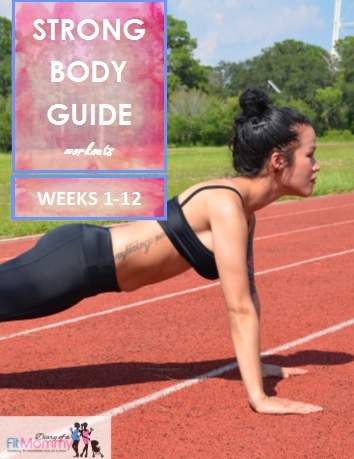
            If you cannot make it to a gym and need to workout from home, try my new Strong Body Guide that is helping busy women worldwide get into their best shape ever. Little to no equipment needed for most moves!
            In this guide, you can expect:
            – ✅ 12 weeks of workouts that can be done at home with little to no equipment.
            – ✅ 225 pages long
            – ✅ Each workout takes less than 30 minutes-great for busy schedules.
            – ✅ step by step instructional picture examples of every move
            – ✅ no gym required
            – ✅ exercises focus on hiit, strength training, and plymetrics
            – ✅ download on any device
            – ✅ build a lean tone stomach, butt, thighs, and arms
            – ✅ download instantly from anywhere
            – ✅ promote fat loss & boost metabolism
            – ✅ contains cardio and stretching routines as well!
            – ✅ full exercise glossary with images and instructions for every move
            *All guides are digital ebooks available instantly worldwide. Compatible on all devices – Android, iPhone, iPad, Kindle, Nook, Computer, Mac.


            Related Posts Plugin for WordPress, Blogger...
            >